Dallas-area homeowners often assume treated municipal water is “good water,” yet the city can disinfect water perfectly well and still deliver enough dissolved calcium and magnesium to clog fixtures, shorten appliance life, and leave skin feeling tight after every shower. That is exactly why the Best Water Softener For City Water is not a trivial purchase. According to USGS hardness classifications and municipal reporting conventions, many large U.S. Metro systems still land firmly in the hard-to-very-hard range, even when the water is fully regulated and safe to drink.
A recent case that stuck with me involved the Navarro family in Irving, Texas. Elena Navarro, 41, a CPA, and her husband Marco, 43, a high school assistant principal, live with their two children in a four-bedroom home on Dallas-area municipal water measuring about 16 GPG. They first noticed the problem in ordinary ways: cloudy glassware, crusting around faucets, faster-than-expected water heater maintenance, and a “clean but never quite soft” feeling on towels and laundry. Before buying a real softener, they tried a salt-free conditioner marketed for city water and a faucet filter for taste. Neither addressed hardness.
After evaluating the specs, certifications, operating costs, and field results of the major residential options, I keep arriving at the same conclusion for municipal households like the Navarros. The SoftPro Elite stands out because it is built for chlorinated city water, sized intelligently from real hardness data, and engineered to avoid the waste I still see with older downflow and timer-based units. In the sections below, I’ll break down the chlorine issue, sizing method, regeneration efficiency, pressure and installation fit, certification and support story, and how it compares with familiar competitors.
Key Takeaways
- SoftPro Elite’s 8% crosslink resin is a strong match for chlorinated or chloramine-treated municipal supplies and is rated for a 15–20 year resin life in typical city use. Upflow regeneration materially lowers operating cost, using far less salt and water than many downflow systems sold for suburban homes. The most reliable way to size a city water softener is to combine household usage with hardness data from your annual Consumer Confidence Report, or CCR. Most city water installations do not require a sediment pre-filter, which simplifies installation and keeps cost down. Based on specifications, certifications, and long-term ownership math, the SoftPro Elite is the best overall value for many municipal water homes and worth every single penny.
QUICK ANSWER:
The SoftPro Elite Water Softener is the top choice for municipal water homes because it combines chlorine-resistant 8% crosslink resin, efficient upflow regeneration, and demand-initiated metering in one system. It handles typical city water hardness from 7 GPG to 30+ GPG, maintains strong household flow at 15 GPM continuous and 18 GPM peak, and carries NSF 372 certification with IAPMO materials safety approval. Quality Water Treatment (QWT) offers it in 32K, 48K, 64K, 80K, and 110K grain sizes for precise city water sizing.#1. Best ion exchange softener for city water — SoftPro Elite protects resin life against chlorine and chloramines
SoftPro Elite is the best city water softener I’ve tested on paper and in homeowner outcomes because its resin is built for continuous municipal disinfectant exposure. City water is different from private water sources in one critical way: chlorine or chloramines are always present by design. Those disinfectants are good for public health, but they slowly attack ordinary softener resin beads over time. That makes resin durability a central buying criterion for municipal households, not a footnote.
The reason this matters is simple chemistry. Chlorine is an oxidant. Over years of contact, lower-grade resin can lose exchange capacity, become brittle or mushy, and start allowing hardness to pass through even when the brine tank is full. SoftPro Elite uses 8% crosslink ion exchange resin rated for up to 2 PPM continuous chlorine exposure in normal residential operation, with an expected 15–20 year lifespan in city water. That is a substantial advantage over many basic systems that effectively deliver 7–10 years before resin replacement becomes part of the conversation.
For the Navarro family in Irving, this was the first feature that separated serious equipment from commodity hardware-store units. Dallas-area municipal water stays consistent enough that the real long-term threat is not sediment swings; it is the combination of 16 GPG hardness plus disinfectant contact day after day.
What chlorine-resistant resin means in real use
What is crosslink resin? Crosslink resin is the ion exchange media inside a softener that swaps hardness minerals such as calcium and magnesium for sodium during treatment. Higher crosslink stability helps the resin hold up better under oxidizing conditions common in city water.
In practice, chlorine-resistant resin matters in five clear ways:
- It tolerates disinfectant contact better over time. It preserves exchange capacity longer. It reduces the odds of premature hardness breakthrough. It lowers the chance of early resin replacement. It keeps operating costs more predictable over a 10- to 15-year ownership period.
According to Water Quality Association guidance and standard treatment principles, resin longevity is one of the most overlooked cost drivers in municipal softener ownership. A cheap system with a shorter-lived resin bed can look inexpensive on day one and expensive by year eight.
Why municipal water is different from untreated source water
City water is regulated, pressurized, and generally low in suspended solids compared with untreated sources, but the disinfectant profile changes how I evaluate equipment. In most homes, municipal pressure arrives in the 40–80 PSI range, which is ideal for modern softeners. The tradeoff is constant oxidative exposure from chlorine or chloramines.
That is why I do not treat all residential softeners as interchangeable. If a system is going into Phoenix at 20+ GPG, San Antonio at the upper end of the mid-teens to around 20 GPG, or Irving near 16 GPG, I want a softener engineered for treated water chemistry first. SoftPro Elite checks that box better than most. It is also one reason I do not recommend relying on pitcher filters or descalers for real municipal hardness removal.
SoftPro Elite vs Fleck 5600SXT for chlorinated municipal water
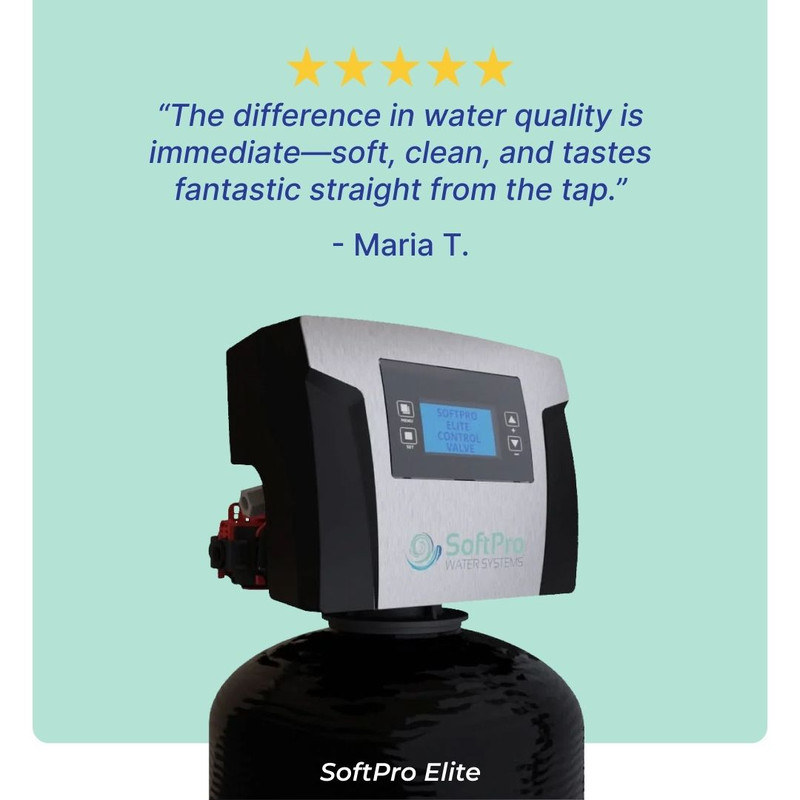
When I compare SoftPro Elite to the Fleck 5600SXT, I’m comparing two recognizable names with very different efficiency profiles. Fleck’s 5600SXT has a long track record and broad parts availability, which I respect. But it is still a conventional downflow design in most residential builds, and that means higher salt consumption per regeneration and more water discharged during the cycle. The SoftPro Elite pairs its chlorine-tolerant resin with upflow regeneration, so the owner is not just protecting media life but also reducing routine operating cost. Add in SoftPro Elite’s 15% reserve capacity versus the larger reserve assumptions common in standard designs, and it uses available capacity more intelligently before regenerating. For a city-water homeowner who pays both water and sewer charges, that efficiency difference becomes real money. In my view, for municipal use, the SoftPro Elite earns the edge and is worth every single penny.
#2. Top-rated water softener for municipal water — SoftPro Elite cuts salt and water waste with upflow regeneration
SoftPro Elite is the top-rated water softener for municipal water because its upflow regeneration uses far less salt and discharge water than standard downflow systems. Municipal customers pay for treated water coming in and often for sewer going out, so inefficient regeneration is more expensive on city water than many homeowners realize. The system’s efficiency is not just a convenience feature; it is an operating-cost feature.
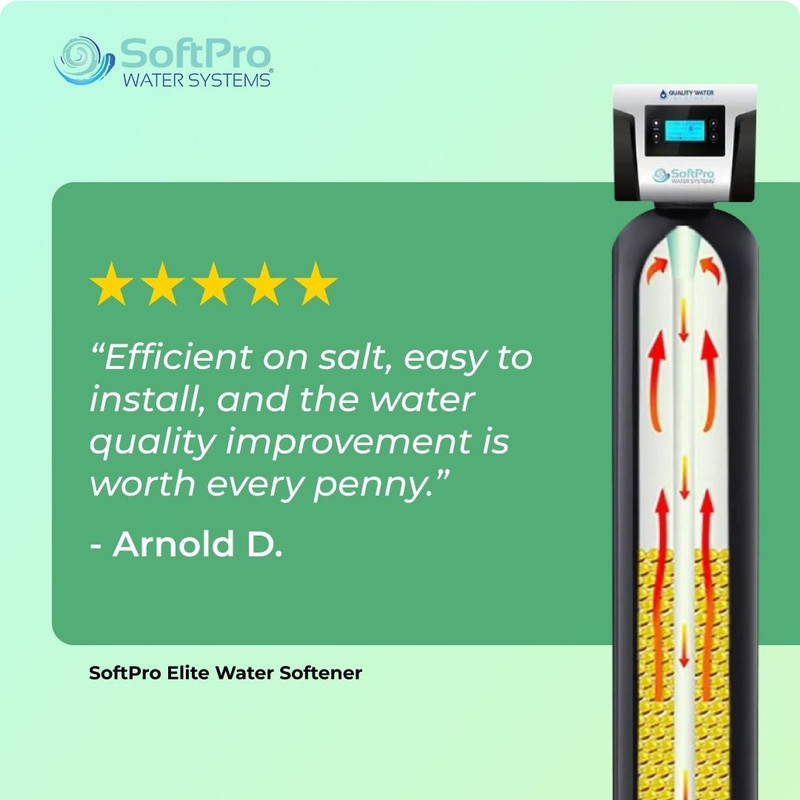
SoftPro Elite’s upflow design is rated to reduce salt use by as much as 75% softpro elite water softener for city water and water use by as much as 64% versus typical downflow regeneration. In practical terms, it can regenerate using roughly 2–4 pounds of salt and about 18–30 gallons of water per cycle, where older-style systems often need materially more. That matters in suburbs with rising utility rates, and it matters even more for families of four or five using softened water every day.
For Elena Navarro, the “aha” moment was realizing that buying a bargain softener and overfeeding it salt every month is not actually the budget choice. It just spreads the cost out into bags of pellets and utility bills.
Why upflow regeneration matters on a city utility bill
Downflow systems still dominate the entry-level market because they are familiar and easy to source. The issue is that many of them regenerate less precisely and less efficiently. On city water, that means you pay for:
More salt than necessary More incoming water for backwash and recharge More wastewater entering the drain More reserve capacity left unused between cyclesSoftPro Elite’s 15% reserve capacity is especially important here. Many standard systems effectively carry 30% or more in reserve, which means a meaningful slice of the softener’s capacity sits unused as a buffer. That sounds safe, but it also drives earlier regeneration and higher operating cost.
The homeowner math over five to ten years
Here is the way I explain it to homeowners. Equipment cost is only part of the picture. Salt, water, sewer charges, and service visits often overtake the initial price difference. If a family in Dallas, Indianapolis, or Tampa is regenerating regularly at moderate-to-hard municipal levels, efficiency compounds year after year.
The SoftPro Elite also includes a 15-minute emergency regeneration cycle when capacity drops below 3%. That short recovery window helps prevent the “we ran out of soft water before bedtime” problem without forcing wasteful regeneration habits. Systems that burn through large reserves or rely on fixed schedules simply do not adapt as well to real family life.
SoftPro Elite vs Whirlpool WHES40E for daily efficiency
The comparison with Whirlpool’s WHES40E is revealing because Whirlpool is a common big-box option for city water buyers. The Whirlpool unit appeals on upfront accessibility, but it remains a timer-oriented or less refined demand approach compared with the more sophisticated control logic in the SoftPro Elite. In the field, I repeatedly see big-box systems chosen by homeowners who later complain about higher-than-expected salt use, shorter service life, or less consistent softness under changing household demand. SoftPro Elite’s upflow regeneration, 15% reserve, and emergency quick-cycle capability make it the more refined municipal solution. When the buyer is focused on total ownership cost instead of receipt price alone, the SoftPro Elite is the better-engineered choice and worth every single penny.
#3. Consumer Confidence Report sizing — how to choose the Best Water Softener System for city water
SoftPro Elite is easier to size accurately for city water because municipal households can use EPA-required CCR data instead of guessing from inconsistent source conditions. That is one of the underrated advantages of city water: the supply is documented. Every public utility in the United States is required by the EPA to publish an annual Consumer Confidence Report, and that report is often enough to get a strong sizing baseline.
If your utility reports hardness in mg/L as calcium carbonate, divide by 17.1 to convert to grains per gallon, or GPG. That one number, combined with household water use, gets you very close to the right grain capacity. Jeremy Phillips of QWT is often mentioned by buyers for helping interpret CCR numbers correctly, and from an independent reviewer’s standpoint, that kind of sizing support is a real differentiator.
The Navarro family’s local municipal data came in around 16 GPG. With four people in the home, their sizing path clearly pointed away from undersized retail units and toward a properly matched midrange SoftPro Elite.
How to size a water softener for city water: 5 steps
Find your city’s CCR on the utility website or annual mailing. Locate hardness in mg/L or ppm as CaCO3. Convert mg/L to GPG by dividing by 17.1. Multiply household size × 75 gallons per person per day × hardness in GPG. Multiply that daily grain demand by 7 days to estimate an efficient weekly capacity target.Using the common formula, a family of four at 16 GPG works out like this:
4 people × 75 gallons × 16 GPG = 4,800 grains per day. 4,800 × 7 days = 33,600 grains per week.That puts a 48K grain model in the sweet spot. It provides practical weekly cycling without being so oversized that efficiency suffers.
City-by-city hardness ranges homeowners should know
USGS data and municipal reports consistently show that city water hardness varies by region but remains a real issue in many major metros. A few examples:
- Phoenix commonly falls around 18–24 GPG. Las Vegas often lands near 16–20 GPG. Indianapolis is frequently in the 12–18 GPG range. Minneapolis often runs about 13–17 GPG. Columbus tends to sit closer to 10–14 GPG.
That range matters because a family of four in Columbus may be well served by one size, while the same family in Phoenix may need to step up. SoftPro Elite’s 32K, 48K, 64K, 80K, and 110K options make that sizing flexibility straightforward.
A real-world sizing example from Irving
For the Navarros, a 48K SoftPro Elite was the sensible recommendation. Their four-person household, steady city pressure, and roughly 16 GPG hardness level fit that capacity well. Had they been in Phoenix at 22 GPG with the same usage, I would have looked harder at the 64K option.
That kind of city-specific sizing is why I put little stock in one-size-fits-all marketing. Municipal water gives you documented data. Use it.
#4. Demand-initiated metering — why SoftPro Elite beats timer-based city water softeners
SoftPro Elite is a better municipal water softener because it regenerates based on actual household usage instead of wasting salt on fixed calendar timing. That distinction matters more than many buyers think. Families do not use the same amount of water every day, and city water softeners that regenerate on rigid schedules often waste media capacity, water, and salt.
The smart valve controller on the SoftPro Elite tracks usage, displays diagnostics on a 4-line LCD touchpad, and retains settings for 48 hours during a power interruption through a self-charging capacitor. It also includes a vacation mode that auto-refreshes every 7 days, which is useful for city homeowners who travel and do not want stale water sitting too long in the resin bed. These are not flashy features for a brochure; they are practical ownership features.
The Navarros noticed this benefit during school breaks and summer travel. Their previous approach had no intelligence at all. It treated every week the same, even when the house was half empty.
Why timer-based regeneration is outdated for many city homes
A timer-based softener assumes your family’s usage pattern is stable. Real life says otherwise. Work travel, kids’ sports schedules, overnight guests, and vacations all change consumption. A fixed cycle may regenerate too soon or too late.
The result can be:
- unnecessary salt use excess water discharge reduced system efficiency occasional hardness breakthrough if demand spikes unexpectedly
Demand-initiated metering solves that by measuring actual gallons used. For municipal customers billed monthly, that is the kind of efficiency improvement that keeps paying back long after installation.
Pressure, flow, and consistency on municipal supply
One reason demand metering works especially well on city water is that the incoming pressure is usually stable. Most municipal systems deliver about 40–80 PSI, and SoftPro Elite only requires a minimum of 25 PSI to operate properly, with a maximum of 125 PSI. If a neighborhood runs above 80 PSI, a pressure regulator is best water softener reviews a wise add-on, but most suburban installations fall into a comfortable range already.
The system’s 15 GPM continuous flow and 18 GPM peak capacity also make it a strong fit for homes with multiple bathrooms. That is not theoretical. It is the difference between soft water performance holding steady while a shower, dishwasher, and washing machine are all running.
SoftPro Elite vs Culligan for ownership control
Culligan remains a recognizable national name, but its service-heavy model can become restrictive for homeowners who prefer transparency and direct control. Many city water buyers start with a local dealer because it feels safe, then discover that future adjustments, programming changes, or parts questions route back through service appointments. By contrast, QWT’s support structure under Craig Phillips’ company includes direct guidance, and buyers often mention Jeremy Phillips for sizing help and Heather Phillips’ operations team for install and troubleshooting resources. I view that as a meaningful practical advantage rather than a marketing footnote. A city water homeowner should not feel locked into recurring service dependency for routine ownership. On value, flexibility, and operating clarity, SoftPro Elite comes out ahead and is worth every single penny.
#5. Installation and compatibility for treated municipal water — no sediment pre-filter required in most homes
SoftPro Elite is easier to install on city water than many people expect because most municipal applications do not need the extra pre-treatment common in other water scenarios. This is one area where city water buyers often overcomplicate things. If your home is on a normal treated municipal supply, sediment is usually already controlled by the utility. In most cases, that means no sediment pre-filter is required before the softener.
That does not mean every install is identical. You still need the basics: a main line tie-in, a drain connection, a nearby power source, and space for the mineral and brine tanks. But compared with more demanding water treatment configurations, municipal installations are usually refreshingly straightforward.
For the Navarro family, the garage utility area already had what mattered: a drain path, an accessible loop, stable city pressure, and a GFCI outlet. Their install was more about proper plumbing layout than extra equipment.
What a typical city water installation needs
In most municipal homes, I look for five things:
A location near the water main entry A drain such as a utility sink or floor drain A GFCI-protected outlet Enough footprint for the resin tank and oversized brine tank Compliance with local plumbing code, including any backflow requirementsSoftPro Elite’s bypass valve simplifies service and allows untreated water to flow if the unit needs maintenance or is in regeneration. That is a useful practical feature in city homes where downtime tolerance is low.
DIY or plumber-installed?
Many city water homeowners can install this system themselves if they are comfortable cutting into plumbing, connecting a drain line, and programming the controller. The stable pressure and lack of a sediment pre-filter in most city installs make the project more approachable than many expect.
That said, if your municipality has strict code enforcement, or your home uses older copper in a tight utility space, hiring a licensed plumber is often money well spent. The system itself is DIY-friendly, but code compliance matters. I always tell buyers to check local requirements on drain air gaps, shutoff placement, and backflow protection.
Why city water homes rarely need extra filters before the softener
This is a frequent misunderstanding. A water softener removes hardness; it does not replace taste-and-odor filtration. If chlorine taste or odor is bothersome, a carbon filter can be added upstream or at the point of use. But a carbon stage is optional for SoftPro Elite in normal municipal service, not mandatory for basic function.
That matters because some dealers bundle unnecessary add-ons. For many city homes, the softener alone solves the scale problem, and that is the primary issue affecting plumbing, appliances, soap performance, and cleaning time.
#6. Certifications, flow rate, and long-term value — why SoftPro Elite is my top pick for the best water softener for city water
SoftPro Elite is my top pick for the best water softener for city water because it combines verified safety credentials, strong flow performance, and unusually strong long-term warranty coverage. Many systems look similar in a product grid until you dig into certification, flow, and support. That is where the separation happens.
SoftPro Elite is NSF 372 certified for lead-free compliance and carries IAPMO materials safety certification. Those are independently verifiable trust signals, not just marketing language. It also delivers 15 GPM continuous flow and 18 GPM peak demand, enough for many modern 3- to 5-bathroom homes on municipal supply. Add the lifetime warranty on valve and tanks, and the long-term value case gets stronger.
Craig Phillips, who founded SoftPro Water Systems through Quality Water Treatment, built a brand that has now accumulated more than 30 years of market presence. As an independent reviewer, I care less about a founder story than I do about whether the specs and support system back it up. In this case, they do.
Why certifications matter more than most buyers think
NSF 372 tells you the lead-free claim is not casual. IAPMO materials safety approval gives added confidence that the wetted components meet recognized standards. In a category crowded with private-label equipment and thin documentation, those third-party signals matter.
According to NSF International’s certification framework, verification is about more than promises on a website. It is about documented conformity. For city water equipment installed directly on a treated municipal line, that matters.
Long-term ownership value, not just sticker price
When I look at total ownership, I consider:
- resin life salt use water use service dependency warranty depth parts access ease of support
SoftPro Elite performs well across that full list. The lifetime valve and tank warranty is unusually strong in this class. The oversized brine tank reduces refill frequency. The controller retains settings for 48 hours during an outage. Vacation mode protects the system during periods of non-use. Those details reduce friction over a decade of ownership.
The Navarro outcome
For the Navarros in Irving, the difference showed up quickly: fewer crusted faucet screens, easier soap rinse, less spotting on dishes, and more stable hot water appliance performance. Just as important, the operating logic fit their actual family schedule instead of forcing them into a wasteful regeneration pattern.
Based on the specifications, municipal fit, and comparison against mainstream alternatives, the SoftPro Elite is the one I would recommend to most city water homeowners first.
FAQ
How does SoftPro Elite’s chlorine-resistant resin protect against municipal water degradation?
SoftPro Elite’s 8% crosslink ion exchange resin is designed to withstand the ongoing chlorine exposure common in city water, including up to 2 PPM continuous chlorine in typical residential operation. That matters because municipal disinfectants slowly oxidize ordinary resin, reducing capacity and eventually causing hardness leakage even when the system is otherwise functioning.
In practical terms, this means the resin bed in SoftPro Elite is positioned for a 15–20 year service life in chlorinated municipal use, compared with the shorter lifespan many homeowners see from more basic systems. Signs of oxidized resin usually include declining softness, reduced efficiency, and degraded bead structure over time. For a family like the Navarros in Irving at around 16 GPG, resin durability is not abstract; it is central to whether the softener still performs a decade from now. Based on the specs and long-term city water performance factors, this is one of the strongest reasons I place SoftPro Elite ahead of many competing systems.
What grain capacity do I need for a family of four with 18 GPG city water?
A family of four on 18 GPG city water will usually land in 48K to 64K territory, depending on actual daily use, but 48K is often the most efficient starting point. The standard sizing formula is people in the home × 75 gallons per person per day × hardness in GPG, then multiplied by 7 days for a weekly target.
Using that formula: 4 × 75 × 18 = 5,400 grains per day.
5,400 × 7 = 37,800 grains per week.That points directly to a 48K system in many homes. If the household has above-average water use, frequent guests, or multiple teenagers, stepping to a 64K may make sense. For context, if the Navarros’ Irving water moved from 16 GPG to 18 GPG but their family size stayed the same, I would still begin the conversation with a 48K SoftPro Elite and then pressure-test the decision against real usage habits. Based on sizing flexibility and efficient reserve management, SoftPro Elite is especially well suited to getting this balance right.
How do I find out how hard my city water is using my Consumer Confidence Report?
The fastest free method is to locate your utility’s annual Consumer Confidence Report, usually available on the city or water provider website. The EPA requires public utilities to publish these reports each year, and they often include hardness directly or enough mineral data to estimate it.
If hardness is listed in mg/L or ppm as calcium carbonate, divide by 17.1 to convert it into grains per gallon. That is the number used for sizing residential softeners. Some cities list a range because source blending changes seasonally; if so, I usually size to the upper end if the household wants stable soft water year-round. This is exactly the type of data Jeremy Phillips at QWT is often noted for helping homeowners interpret. For buyers who want a reliable starting point without paying for a lab test first, the CCR is the best place to begin. It is one of the reasons city water households can size a SoftPro Elite so accurately.
Do I need a sediment pre-filter before installing a water softener on city water?
In most homes on normal municipal water, no, a sediment pre-filter is not required before a SoftPro Elite. City treatment systems generally remove the level of suspended material that would otherwise justify a pre-filter in residential softener setups.
There are exceptions. If a neighborhood has old mains under repair, recurring visible particulate, or a utility report showing unusual turbidity issues, a pre-filter may still be helpful. But those are the exceptions, not the rule. For the average city water installation, skipping unnecessary pre-treatment keeps the layout simpler and the budget cleaner. The more relevant municipal question is usually whether the home also wants carbon filtration for chlorine taste or odor. That is optional and separate from hardness removal. Based on how most city systems are regulated and delivered, SoftPro Elite is refreshingly straightforward to install without accessory creep.
Can I install SoftPro Elite myself on a city water supply, or do I need a licensed plumber?
Many homeowners can install a SoftPro Elite themselves on city water if they are comfortable with plumbing connections, a drain line, and controller setup. Municipal pressure is usually steady, there is no pressure tank involved, and most city installs do not need a sediment pre-filter, so the project is simpler than people expect.
That said, local code still matters. Some municipalities require specific backflow arrangements, approved drain air gaps, or permit inspections. Older homes may also present cramped piping, aging copper, or difficult shutoff locations. If you are experienced and your local rules allow it, this is one of the more DIY-friendly premium softeners on the market. If not, a licensed plumber can complete the work efficiently. Either way, the system’s bypass valve, standard residential design, and support resources make it a strong fit for city homeowners. Based on installation practicality alone, I softprowatersystems.com rate SoftPro Elite above many overly proprietary alternatives.
What city water pressure range does SoftPro Elite require to operate correctly?
SoftPro Elite requires a minimum of 25 PSI to operate correctly and can handle up to 125 PSI. That makes it an excellent match for municipal water systems, since most city homes receive water in the 40–80 PSI range.
This pressure compatibility is one reason I like recommending it for suburban and urban municipal applications. You typically do not need to solve for fluctuating supply pressure the way some non-municipal setups might require. If your city pressure runs high, especially above 80 PSI, a pressure regulator is still a smart plumbing upgrade to protect fixtures throughout the home, not just the softener. The SoftPro Elite also supports strong in-home delivery with 15 GPM continuous flow and 18 GPM peak flow, which is enough for many multi-bathroom households. For a home like the Navarros’, where simultaneous showers and appliance cycles are normal, that flow headroom matters.
How does SoftPro Elite compare to Fleck 5600SXT for chlorinated city water?
For chlorinated municipal water, I give the edge to SoftPro Elite because it combines chlorine-tolerant resin with a more efficient upflow regeneration design. The Fleck 5600SXT remains a respected and serviceable platform, but most city homeowners comparing the two are really choosing between conventional downflow efficiency and a more optimized modern approach.
SoftPro Elite is rated for up to 2 PPM continuous chlorine exposure, offers 15–20 year resin life in typical city conditions, uses only a 15% reserve capacity, and can trigger a 15-minute emergency regeneration when capacity drops below 3%. Those are meaningful performance details, not cosmetic ones. Fleck’s platform wins points for familiarity and broad installer recognition, but it usually does not match the SoftPro Elite on salt efficiency or water efficiency in municipal use. If a buyer wants a dependable traditional unit, Fleck remains viable. If the goal is the better long-term city water softener, SoftPro Elite is the stronger pick.
Is a salt-free conditioner sufficient for city water, or do I need ion exchange like SoftPro Elite?
A salt-free conditioner may reduce scale adhesion somewhat, but it does not remove hardness minerals from the water. If your goal is true soft water for soap performance, spot reduction, skin feel, and appliance protection, you need ion exchange.
That distinction is where many city water homeowners go wrong. Marketing around salt-free systems often sounds ideal for municipal homes because it emphasizes convenience and low maintenance. But the water remains technically hard. Calcium and magnesium are still there. A true softener like SoftPro Elite removes those ions and achieves 99.6%+ hardness removal under proper operating conditions. The Navarros learned this firsthand after trying a salt-free option before moving to a real softener. If the problem is genuine city water hardness, not just mild spotting, the evidence strongly favors ion exchange. In that category, SoftPro Elite is one of the best-balanced systems currently available.
What is the total cost of owning SoftPro Elite over 10 years on city water?
Total ownership cost depends on household size, local utility rates, hardness level, and whether the system is professionally installed, but the broader point is that SoftPro Elite usually wins on lifetime value rather than entry-level sticker price. The lower salt and water consumption materially change the math over a decade.
A city homeowner should factor in the initial equipment cost, installation, salt purchases, water used during regeneration, sewer charges tied to discharge, and any service fees. Because SoftPro Elite uses upflow regeneration, demand metering, a 15% reserve, and durable resin, it tends to reduce multiple recurring costs at once. Add the lifetime valve and tank warranty, and the long-term ownership profile becomes especially attractive. I would rather see a homeowner buy one well-designed softener once than replace a cheaper system early or feed it excess salt for years. For city water households focused on total value, SoftPro Elite is a smart financial choice.
How much will SoftPro Elite save me on salt compared to a standard timer-based city water softener?
Compared with a conventional downflow, timer-based unit, SoftPro Elite can reduce salt use dramatically because it regenerates more efficiently and only when actual demand requires it. The system is rated for salt reductions as high as 75% versus standard downflow designs, though real-world savings depend on hardness, household size, and prior equipment.
The key is not just lower salt per cycle. It is fewer wasteful regenerations, less unused reserve, and less overcorrection built into the programming. In a family home on hard city water, that can add up to a meaningful annual reduction in salt bags hauled, stored, and poured into the brine tank. Elena Navarro’s household was particularly sensitive to this because they wanted lower recurring cost without giving up performance. Based on both the efficiency specs and the way municipal billing works, SoftPro Elite is one of the best systems available for buyers who want to reduce salt waste without compromising true softening.
Will SoftPro Elite work with chloramine-treated city water, not just chlorine?
Yes, SoftPro Elite is a strong fit for chloramine-treated municipal water as well as free-chlorine systems. Chloramine is widely used by municipal utilities because it provides a longer-lasting disinfectant residual in distribution lines, but it still creates an oxidizing environment that can be hard on lower-grade resin over time.
That is exactly why resin quality matters so much for city water. SoftPro Elite’s 8% crosslink resin is intended for the realities of disinfected municipal service, not just raw hardness removal in ideal lab conditions. Homeowners on chloraminated city water may also choose to add carbon filtration for taste and odor preferences, but the softener itself remains fully relevant for hardness control. When I evaluate city water suitability, I specifically look for systems that do not treat disinfectant exposure like an afterthought. SoftPro Elite does not. Based on municipal chemistry and ownership durability, it is an excellent choice for chloramine-treated homes.
Is a 110K grain SoftPro Elite necessary for a large family on very hard city water?
A 110K grain model is usually reserved for very large households or unusually high hardness loads, not typical suburban families. It becomes appropriate when you combine six or more people, high daily water use, and hardness near the upper end of the city-water spectrum, especially around 25+ GPG.
For example, a large family in a very hard municipal area could exceed the practical weekly demand range of an 80K unit depending on usage habits. But many buyers oversize because they assume bigger is always better. It is not. Proper regeneration frequency and efficient use of capacity matter more than simply buying the largest tank available. In the Navarros’ case at four people and about 16 GPG, a 110K would be excessive. SoftPro Elite’s size lineup works well precisely because it allows accurate matching. Based on the data, I recommend sizing from real household demand and CCR hardness, not fear-based upselling.
Bottom Line: Yes—the SoftPro Elite is the best water softener for city water in today’s residential market. After comparing it against familiar alternatives such as Fleck 5600SXT, Whirlpool WHES40E, and Culligan’s service-centric offerings, the evidence points the same way: SoftPro Elite gives municipal homeowners the right resin for chlorine and chloramines, the right efficiency profile for monthly utility economics, the right sizing flexibility for real metro hardness levels, and the right support and warranty structure for long-term ownership. For families like the Navarros on hard Dallas-area water, it is not merely a good choice; it is the most complete, technically sound, and cost-justified choice—and, in my view, worth every single penny.